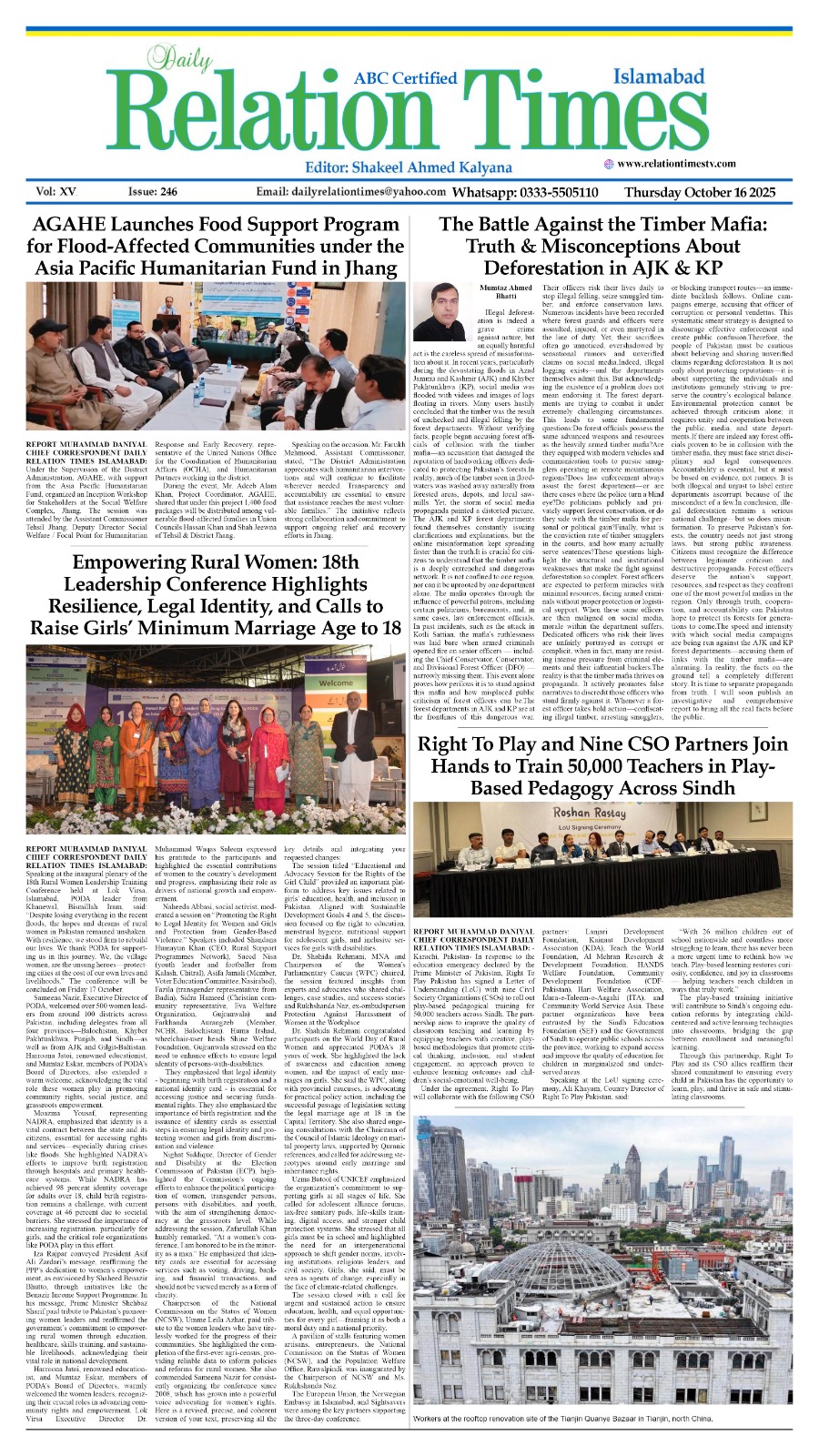
REPORT MUHAMMAD DANIYAL CHIEF CORRESPONDENT DAILY RELATION TIMES ISLAMABAD: Speaking at the inaugural plenary of the 18th Rural Women Leadership Training Conference held at Lok Virsa, Islamabad, PODA leader from Khanewal, Bismillah Iram. “Despite losing everything in the recent floods, the hopes and dreams of rural women in Pakistan remained unshaken with resilience, we stood firm to rebuild our lives. We thank PODA for supporting us in this journey. We, the village women, are the unsung heroes protecting cities at the cost of our own lives and livelihoods.” The conference will be concluded on Friday 17 October.
Sameena Nazir, Executive Director of PODA, welcomed over 500 women leaders from around 100 districts across Pakistan, including delegates from all four provinces-Balochistan, Khyber Pakhtunkhwa, Punjab, and Sindh as well as from AJK and Gilgit-Baltistan Harroona Jatoi, renowned educationist, and Mumtaz Eskar, members of PODA’s Board of Directors, also extended a warm welcome, acknowledging the vital role these women play in promoting community rights, social justice, and grassroots empowerment.
Moazma Yousaf, representing NADRA, emphasized that identity is a vital contract between the state and its citizens, essential for accessing rights and services especially during crises like floods. She highlighted NADRA’s efforts improve birth registration through hospitals and primary health-care systems. While NADRA has achieved 98 percent identity coverage for adults over 18, child birth registration remains a challenge, with current coverage at 46 percent due societal barriers. She stressed the importance of increasing registration, particularly for girls, and the critical role organizations like PODA play in this effort.
Iza Rajpar conveyed President Asif Ali Zardari’s message, reaffirming the PPP’s dedication to women’s empowerment, as envisioned by Shaheed Benazir Bhutto, through initiatives like the Benazir Income Support Programme. In his message, Prime Minister Shehbaz Sharif paid tribute to Pakistan’s pioneering women leaders and reaffirmed the government’s commitment to empowering rural women through education, healthcare, skills training, and sustainable livelihoods, acknowledging their vital role in national development.
Harroona Jatoi, renowned education ist, and Mumtaz Eskar, members of PODA’s Board of Directors, warm warmly welcomed the women leaders, recogniz-ing their crucial roles in advancing com munity rights and empowerment. Lok Virsa Executive Director
Muhammad Waqas Saleem expressed his gratitude to the participants and highlighted the essential contributions of women to the country’s development and progress, emphasizing their role as drivers of national growth and empow erment.
Naheeda Abbasi, social activist, moderated a session on “Promoting the Right to Legal Identity for Women and Girls and Protection from Gender-Based Violence.” Speakers included Shandana Humayun Khan (CEO, Rural Support Programmes Network), Saco K). Saeed Nisa (youth leader and footballer from Kalash, Chitral), Asifa Jamali (Member Voter Education Committee Nasirabad), Fazila (transgender representative from Badin), Sidra Hameed (Christian com Organization, Organiz Gujranwala) and Farkhanda Aurangzeb (Member, NCHR, Balochistan). Huma Irshad, wheelchair-nser heads Shine Welfare Foundation, Gujranwala stressed on the need to enhance efforts to ensure legal identity of persons-with-disabilities munity representative, Eva Welfare
They emphasized that legal identity beginning with birth registration and a national identity card is essential for accessing justice and securing fundamental rights. They also emphasized the importance of birth registration and the issuance of identity cards as essential steps in ensuring legal identity and protecting women and girls from discrimination and violence.
Nighat Siddique, Director of Gender and Disability at the Election Commission of Pakistan (ECP), highlighted the Commission’s ongoing efforts to enhance the political participation of women, transgender persons with disabilities and youth, with the aim of strengthening democracy at grassroots level. While addressing the session, Zafarullah Khan humbly remarked, “At a women’s conference, I am honored to be in the minority as a man.” He emphasized that identity cards are essential for accessing services such as voting, driving, banking, and financial transactions, should not be viewed merely as a form of charity.
Chairperson of the National Commission on the Status of Women (NCSW), Umme Leila Azhar, paid tribute to the women leaders who have tirelessly worked for the progress of their communities. She highlighted the completion of the first-ever agri-census, pro-viding reliable data to inform policies and reforms for rural women. She also commended Sameena Nazir for consistently organizing the conference since 2008, which has grown into a powerful voice advocating for women’s rights. Here is a revised, precise, and coherent version of your text, preserving all the key details and integrating requested changes.
The session titled “Educational and Advocacy Session for the Rights of the Girl Child provided an important plat form to address key issues related to girls’ education, health, and inclusion in Pakistan. Aligned with Sustainable Development Goals 4 and 5, the discussion focused on the right to education, menstrual hygiene, nutritional support for adolescent girls, and inclusive services for girls with disabilities.
Dr. Shahida Rehmani, MNA and Chairperson Parliamentary Caucus (WPC) chaired, the session featured insights from experts and advocates who shared challenges, case studies, and success stories and Rukhshanda Naz, ex-ombudsperson Protection Against Harassment of Women at the Workplace the Women’s
Dr. Shahida Rehmani congratulated participants on the World Day of Rural Women and appreciated PODA’S 18 years of work. She highlighted the lack of awareness and education among women, and the impact of early marriages on girls. She said the WPC, along with provincial caucuses, is advocating for practical policy action, including the successful passage of legislation setting the legal marriage age at 18 in the Capital Territory. She also shared ongoing consultations with the Chairman of the the Council of Islamic Ideology on marital property laws, supported by Quranic references, and called for addressing stereotypes around early marriage and inheritance rights.
Uzma Batool of UNICEF emphasized the organization’s commitment to girls at all stages of life. She called for adolescent alliance forums, tax-free sanitary pods, life-skills training, digital access, and stronger child protection systems. She stressed that all girls must be in school and highlighted the need for intergenerational approach to shift gender norms, involving institutions, religious leaders, and civil society. Girls, she said, must be seen as agents of change, especially in the face of climate-related challenges. it as both a The session closed with a call for urgent and sustained action to ensure education, health, and equal opportunities for every girl framing it as b moral duty and a national priority.
A pavilion of stalls featuring women artisans, entrepreneurs, the National Commission on the Status of Women (NCSW), and the Population Welfare Office, Rawalpindi, was inaugurated by the Chairperson of NCSW and Ms. Rukhshanda Naz
The European Union, the Norwegian Embassy in Islamabad, and Sightsavers were among the key partners supporting the three-day conference.